 LitMemo
Three-Act Structure for Novels: Plot Points, Midpoint, Word Counts, and a Worked Example
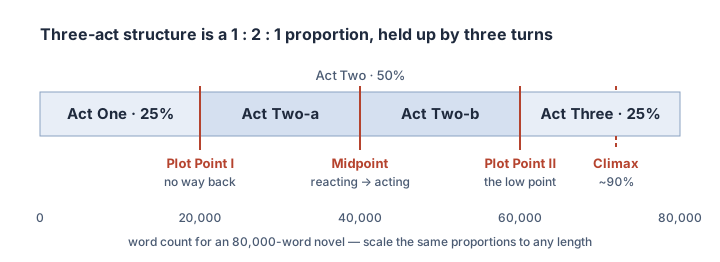
Here's the conclusion first: three-act structure isn't three equal parts. It's a 1:2:1 proportion carved out by two plot points. Act One runs about a quarter, Act Two takes half, Act Three the final quarter. Nearly every long novel that stalls, stalls in Act Two — it's as long as the other two acts combined, and it's the least planned. The thing to decide first isn't what happens in each act. It's where the two turns land.
What three-act structure actually says
The idea traces back to Aristotle, but the version working writers use today was systematised by American screenwriter Syd Field in his 1979 book Screenplay: The Foundations of Screenwriting.
It splits a story into three sections with different jobs:
| Act | Job | Rough share |
|---|---|---|
| One | Setup — establish time, place, people, the ordinary world, and plant the problem | 1/4 |
| Two | Confrontation — the protagonist pushes toward a goal and things keep getting worse | 1/2 |
| Three | Resolution — the conflict peaks, resolves, and a new normal settles | 1/4 |
Field's model — he called it the Paradigm — does one more useful thing: it splits the long middle act into 2a and 2b, and introduces plot points, the structural events at roughly fixed positions that shove the story into its next act.
Convert the proportion to word count
Ratios stay abstract until you put your own length into them:
| Total words | Act One | Act Two | Act Three |
|---|---|---|---|
| 100,000 | ~25,000 | ~50,000 | ~25,000 |
| 200,000 | ~50,000 | ~100,000 | ~50,000 |
| 300,000 | ~75,000 | ~150,000 | ~75,000 |
Most writers' first reaction to this table is "my Act One is way too long." That's the normal failure, and it has a cause: setup is the most comfortable stretch to write. The world is fresh, the characters are arriving, the prose flows. Reader patience does not track author comfort.
The table above uses serial lengths. For a debut novel aimed at agents and traditional publishers, the working range is 60,000–100,000 words, and the three turns land here (the climax follows at about 90%):
| Total words | Plot Point I · 25% | Midpoint · 50% | Plot Point II · 75% |
|---|---|---|---|
| 60,000 | ~15,000 | ~30,000 | ~45,000 |
| 80,000 | ~20,000 | ~40,000 | ~60,000 |
| 90,000 | ~22,500 | ~45,000 | ~67,500 |
| 120,000 | ~30,000 | ~60,000 | ~90,000 |
At 3,000 words a chapter, an 80,000-word novel puts Plot Point I in chapter 6 or 7, the midpoint in chapter 13 or 14, and Plot Point II around chapter 20. Those three chapter numbers are the first thing to write into the outline; the novel outline template has a row for each.
The two plot points are the actual skeleton
Acts don't fade into each other. They're separated by events.
Plot Point I (end of Act One): the protagonist loses the option not to be involved. Before it, they could go back to ordinary life. After it, they can't. The job is accepted, the person dies, the door closes. This turn defines what the book is about.
Plot Point II (end of Act Two): the protagonist hits bottom and, in the same stroke, gains what they need for one last attempt. Usually they lose something that matters in exchange for finally seeing clearly.
There's a quick test for whether your turn is doing its job: remove it — does the story still proceed the same way? If it does, you have an event, not a plot point.
Why Act Two collapses
Act Two is half the book, and it's routinely covered in an outline by one line: "the protagonist faces various obstacles."
That line will not produce 50,000 words. In practice three symptoms show up — subplots multiply without end, characters stand around discussing things, obstacles resolve too easily. All three have the same root: Act Two has no support in the middle.
The boundary where Field split 2a from 2b is commonly called the midpoint. Its job is to invert the protagonist's relationship to the problem: from reacting to acting, or from pursuing a goal to discovering that goal was wrong.
Practically, deciding the midpoint first is what stops Act Two being a blank — you get two stretches of roughly 25,000 words each, both with a direction. This is also the structural reason writer's block clusters in the middle of a book. The ideas didn't run out; that stretch was never designed.
A worked example: Pride and Prejudice in three acts
Austen wrote sixty-one chapters and no act breaks, which makes the novel a fair test: the structure has to be found, and it is there.
| Turn | Chapters (of 61) | Position |
|---|---|---|
| Setup | 1–3 | 0–5% |
| Plot Point I | 19–22 | ~33% |
| Midpoint | 34–36 | ~56% |
| Plot Point II | 46 | ~75% |
| Climax | 56–58 | ~93% |
| Resolution | 59–61 | 97–100% |
- Setup (ch. 1–3). Bingley takes Netherfield; at the Meryton assembly Darcy declines to dance with Elizabeth, and she overhears why.
- Plot Point I (ch. 19–22). Elizabeth refuses Mr Collins; Charlotte Lucas accepts him days later. Elizabeth has now turned down the safe marriage, in a family with no inheritance, and cannot take the refusal back.
- Midpoint (ch. 34–36). Darcy proposes at Hunsford and is refused; the next morning his letter explains Wickham and Jane. Elizabeth's reading of every earlier event reverses.
- Plot Point II (ch. 46). Lydia elopes with Wickham. The family's standing collapses, and with it any prospect Elizabeth had — the low point, and the moment she understands what she has lost.
- Climax (ch. 56–58). Lady Catherine demands Elizabeth promise never to accept Darcy; Elizabeth refuses. Darcy proposes again and is accepted.
- Resolution (ch. 59–61). The two marriages; Longbourn's new normal.
Three things to take from the mapping. Act One runs to a third of the book, which is the loose end of the range and reads as leisurely to modern readers. The midpoint is a reversal of knowledge, with Elizabeth's goal unchanged but her understanding of the two men inverted, and the second half of the book is her acting on that. And Plot Point II is a loss that has nothing to do with Darcy on its surface: the low point of a romance can be a blow to the family, the money, or the reputation, as long as it closes the road to the ending.
Try the same table on the last novel you finished. If you can fill the middle three rows from memory, the book had a spine; if you can only fill the first and last, that is usually the book you remember as "good but long in the middle".
Three ways novels differ from screenplays
The model comes from screenwriting, and porting it straight into prose hits three problems.
1. Length isn't runtime, so loosen the ratio. A film is 120 minutes and the proportions hold tightly. Novels — serials especially — run looser, and an Act One at 30% is common. Treat the ratio as a range to check against, not a standard to pass.
2. Novels can carry multiple lines; screenplays usually can't. Ensemble and multi-POV books tend to give each line its own three acts, deliberately offset from one another. The real question becomes whether the lines' turns should align — usually staggering them is better, so the whole book doesn't peak in one chapter and go slack together. On handling the switches, see first person vs third person.
3. Serialisation rewrites the rules for Act One. A screenplay can take its time setting up. A serial can't — readers re-decide at every chapter. The usual serial move is to pull Plot Point I much earlier, get the story moving, and backfill setup along the way. That's why opening technique carries disproportionate weight in serial publishing.
Three common misuses
Treating the acts as three chapters. Acts are functional regions, not a table of contents. Act One might be fifteen chapters.
Fitting the frame before you have the story. Three-act structure is a diagnostic, not a generator. It will tell you Act Two has no support; it won't invent that support for you. Story first, check second.
Assuming it applies to everything. Plenty of slice-of-life, essayistic, and stream-of-consciousness work deliberately refuses this shape. If your story isn't driven by "protagonist wants something and meets resistance," forcing the frame just distorts it.
The three-act worksheet: nine questions to answer before outlining
The frame becomes usable when it turns into questions about your story. Answer these nine in one or two sentences each; the ones you cannot answer are the stretches of the book that have no design yet.
- Normal world. What is the protagonist doing in the opening scene, and what does that scene show about who they are?
- The break. What event ends the normal world? It should happen to them, and it should be irreversible.
- The want. After the break, what does the protagonist want, in one sentence they could say aloud?
- Plot Point I. What choice closes the door behind them? Remove it: does the story still proceed the same way? If yes, the choice is too small.
- Act Two-a. What is the protagonist doing for the next quarter of the book? "Reacting" is the right kind of answer; "facing obstacles" is a blank.
- Midpoint. What do they learn or lose that turns reacting into acting, or shows the want was wrong?
- Act Two-b. What are they now going after, and what is the cost rising toward?
- Plot Point II. What do they lose at the bottom, and what do they finally see because of it?
- Climax and image. What is the choice at the climax that they could not have made in chapter one — and what is the closing scene that shows the change against the opening one?
Questions 4, 6, and 8 are the skeleton; questions 5 and 7 are the two halves of Act Two, which is where most outlines are one line long. If you want the questions as a table with word-count rows already filled in, the novel outline template carries the same seven turns as fields.
Three acts, four acts, five acts: when to switch frames
The three-act model is the default, and two other frames are worth knowing because they solve problems it leaves open.
Four acts. Splitting Act Two at the midpoint produces four roughly equal quarters, and many working novelists plan in four for that reason: every act is about 20,000 words, and none of them is the fifty-thousand-word blank. Nothing changes about the turns; the midpoint is promoted from a support inside Act Two to an act break. Serials in particular tend to run better on four, because a quarter is a natural arc length for a reader who is deciding weekly whether to keep going.
Five acts (Freytag's pyramid). Exposition, rising action, climax, falling action, dénouement. The difference from three acts is where the climax sits: in the centre, with a long falling action after it. That shape fits tragedy, where the second half is the consequence playing out, and it fits literary novels that are about aftermath. It fits a thriller badly, because a thriller that peaks at the halfway mark has nothing left to sell.
Twelve or fifteen beats. The hero's journey and the fifteen-beat sheet are finer subdivisions of the same three acts, with named beats at fixed positions. They are useful when Act Two is still a blank after the nine questions above, and a liability when a story that is not about a hero's transformation gets bent to fit one. The beat sheet template is the place to lay one out.
The test for switching frames is practical: use the one that makes the empty stretch of your book visible. For most novels that is three acts with a marked midpoint; for a tragedy it is five; for a serial it is often four.
Getting it into the outline
The model only earns its keep when it lives in your actual outline rather than as a diagram in a notebook.
The practical move is to use outline groups as acts: create Act One / Act Two-a / Act Two-b / Act Three, and drop beats into them as they occur to you. Then the empty group is visible at a glance — an empty group is a stretch you haven't designed yet.
Mark the two plot points and the midpoint separately and treat them as stakes; let everything else move freely between them. When you realise mid-draft that a turn belongs earlier, move it and let the surrounding beats reshuffle. That's the core of dynamic outlining — structure is only usable if it can change.
If you want a ready-made format, start from the story outline template or the beat sheet template.
In short
Three-act structure answers four questions:
- Where is Plot Point I — when does the protagonist lose the option to walk away?
- Where is the midpoint — when do they stop reacting and start acting?
- Where is Plot Point II — when do they hit bottom?
- Are the spans between those three points proportioned sensibly?
Whichever one you couldn't answer is the weakest part of your story right now.
And structure is something you adjust while writing, not before. LitMemo lets you group your outline into acts and reorder beats freely, with characters, foreshadowing, and timeline linked to each beat — so changing the structure doesn't scatter your continuity. Start from the story outline template →