Keep your drawing app — leave the production to LitMemo
It doesn't replace your art tool — LitMemo is your manga production hub: settings that stay in sync, storyboard, dialogue lettering and progress tracking tied into one line, and art you either upload yourself or generate with AI.
Get started nowLitMemo's manga production tools don't fight the Clip Studio / drawing app in your hands — they act as your production command center: lay out the storyboard, place dialogue, and track progress all in one place, with every panel's characters and scenes wired straight to the character art and worldbuilding settings you've built, so the art never drifts from the settings. Two paths for the art itself — draw in the app you already use and upload panel by panel, or generate each panel with AI. From settings and storyboard through to the finished export, the whole middle is tied together, so you stop shuffling files between three apps for notes, storyboard, and drawing.
"Settings live in my notes, the storyboard in one app, the artwork in my drawing software — change one thing and I have to sync all three by hand..."
The most tedious part of making manga isn't the drawing — it's tying settings, storyboard, dialogue, progress, and art files together. What you need isn't yet another drawing app; it's a production hub that ties these together and actually remembers your settings.
The core features of Manga production software — keep your art app, from settings to a finished page
A production hub where settings and storyboard stay in sync
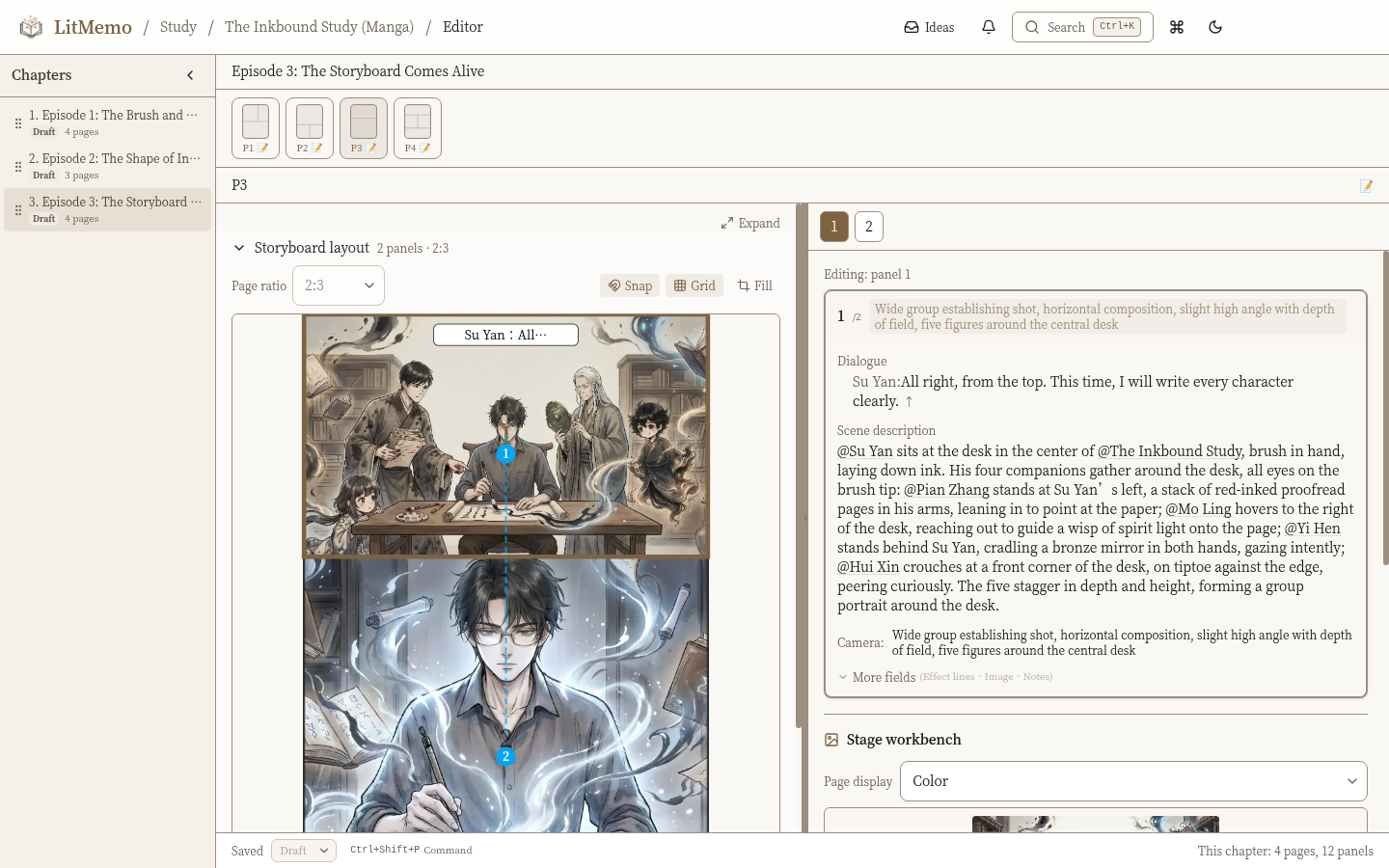
The storyboard editor keeps panels, dialogue, camera, and layout in one place, and every panel's characters and scenes are wired straight to the worldbuilding settings you've built in LitMemo — change a setting and the art prompts follow, so the settings never drift mid-draw.
- Storyboard editor: panels / dialogue / camera / layout / spreads
- Every panel wired to your character art and worldbuilding settings
- Dialogue lettering + nine-grid positioning + safe area
Two paths for the art: upload your own or AI-generate
The drawing step isn't locked in: draw in the art app you already use and upload a white-background PNG panel by panel into the layout, or generate each panel with AI — mix both if you like. LitMemo fits the result into the layout, overlays the dialogue, and composes the finished page.
- Upload your own art panel by panel (white-background PNG into the layout)
- Or generate each panel with AI
- Page composition flattens art + dialogue into a finished page
Progress, import and export
You don't lay out the storyboard from scratch — import it smartly from images, script text, or existing storyboard images; see each page's completion and which production stage it's reached at a glance, and export the finished storyboard in one click.
- Smart import from images / script / storyboard images
- Page completion and production stage at a glance
- Export the finished storyboard in one click
Have you run into this too?
「Settings, storyboard, and art files are scattered across three places and constantly synced by hand」
LitMemo acts as the production hub tying settings, storyboard, dialogue, and progress together — art comes in whether you upload it or generate it with AI — so changing one thing doesn't mean patching everywhere.
「You want to draw in Clip Studio, but you keep flipping back and forth to check the settings」
Every storyboard panel is wired straight to your characters and worldbuilding settings, so the prompts sit right beside you as you draw; upload panel by panel when you're done and it fits into the layout.
「You don't have time to draw every panel and want AI to lay down a base first」
Each panel can be AI-generated panel by panel (characters stay consistent) — lay down a base first, then decide which panels to refine and upload yourself.
The usual way vs LitMemo
| The usual way | LitMemo | |
|---|---|---|
| Positioning | Yet another drawing app | The production hub for your drawing app |
| Sync with settings | Each on its own, flip through settings by hand | Every panel wired straight to characters/worldbuilding |
| Art source | Locked to a single method | Upload your own or AI-generate, mix and match |
| Dialogue lettering | Handled in separate software | Laid out and positioned inside the storyboard |
| Storyboard starting point | Start from a blank page | Smart import from images / script / storyboard images + templates |
Get started in four steps
- 1
Build characters and worldbuilding
Set up characters and settings in LitMemo first, so the storyboard has something to wire to
- 2
Lay out the storyboard
Use the storyboard editor to lay out panels, dialogue, camera, and layout, each panel synced to the settings
- 3
Draw each panel
Draw in your own app and upload, or generate each panel with AI
- 4
Compose and export
Compose the page, overlay dialogue, and export the finished storyboard
Frequently asked questions
No, and it's not trying to. LitMemo is the production hub 'around' your drawing software: it manages settings, lays out the storyboard, places dialogue, and tracks progress. Keep drawing in the app you already use — draw a panel, upload it, and it fits into the layout; or if you want it easy, generate it with AI. The two complement each other.
No. There are two paths for the art: draw in your own app and upload panel by panel, or generate each panel with AI — mix and match freely. AI is just an option, not a requirement.
Yes — that's exactly the strength: every storyboard panel is wired straight to the characters and worldbuilding settings you've built in LitMemo, so the art stays in sync with the settings and never drifts.
Production features like the storyboard, dialogue lettering, and uploading your own art work on the free plan; AI generation is a paid-plan feature (credits by tier), so you only move up when you want more art.
Wherever the pen rests, there is home
Don't let cracks in the details
ruin your good story
Start now, and scale up as your work grows