
Character Relationship Chart Template
Who relates to whom, and why — one connection per row, turning a tangled web of characters into a single clear list.
Use this template onlineA character relationship chart uses "Character A + relationship type + Character B," one row at a time, to flatten your web of characters into a single list. Once you have a big cast, keeping mentor-student, lovers, and rivals all in your head is how mistakes slip in — someone's a friend early on, then inexplicably a sworn enemy later. This template helps you spell out the backstory of every relationship, and applying it online lets you sort it all out right alongside your character sheets.
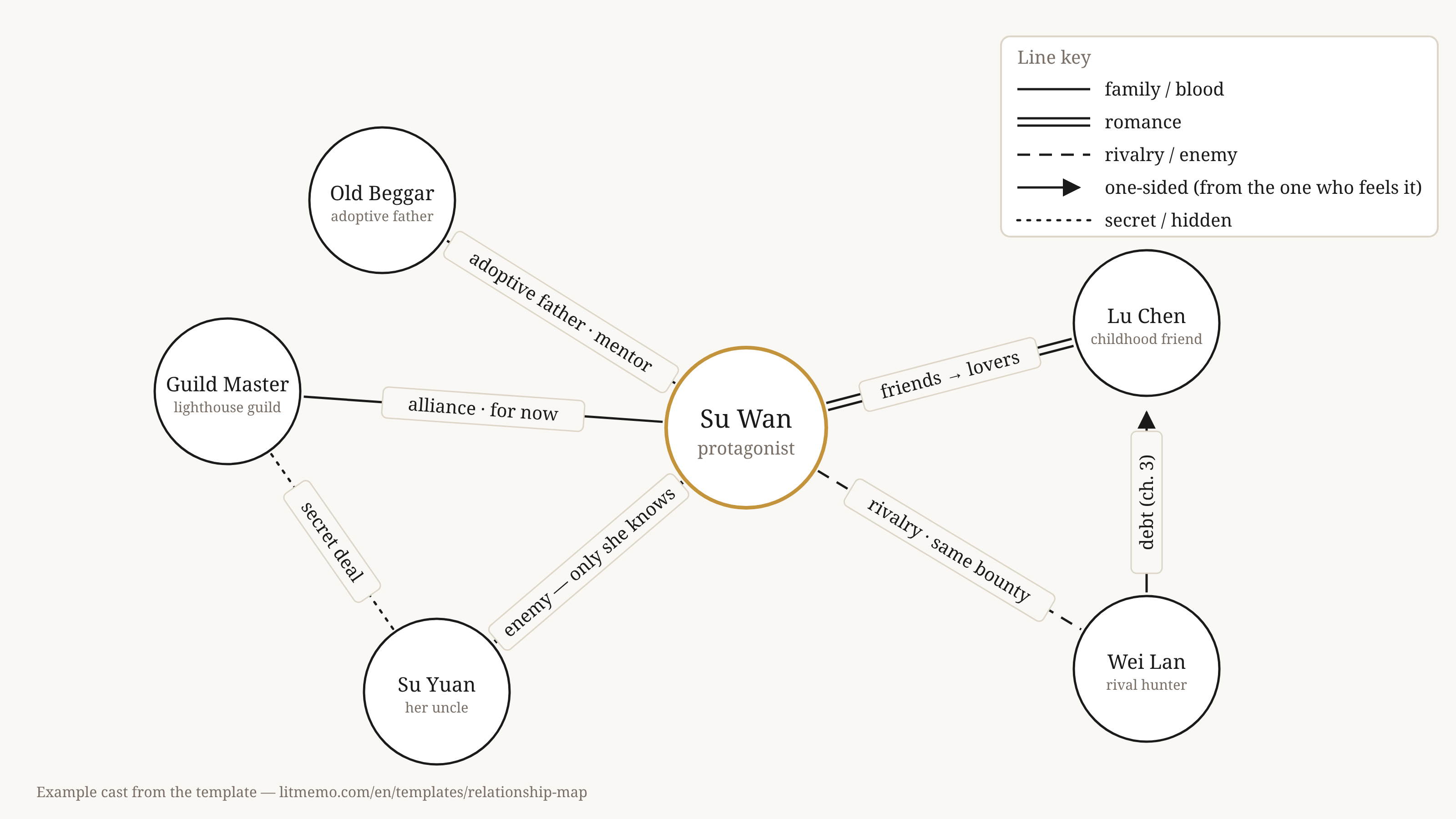
Template preview
Character relationship chart column examples
| Field | Example |
|---|---|
| Character A | Su Wan |
| Relationship type | Childhood friends → lovers |
| Character B | Lu Chen |
| Relationship notes | Grew up on the same alley; separated for ten years when the city fell; reunite in Volume Two and slowly develop feelings |
Printable blank version
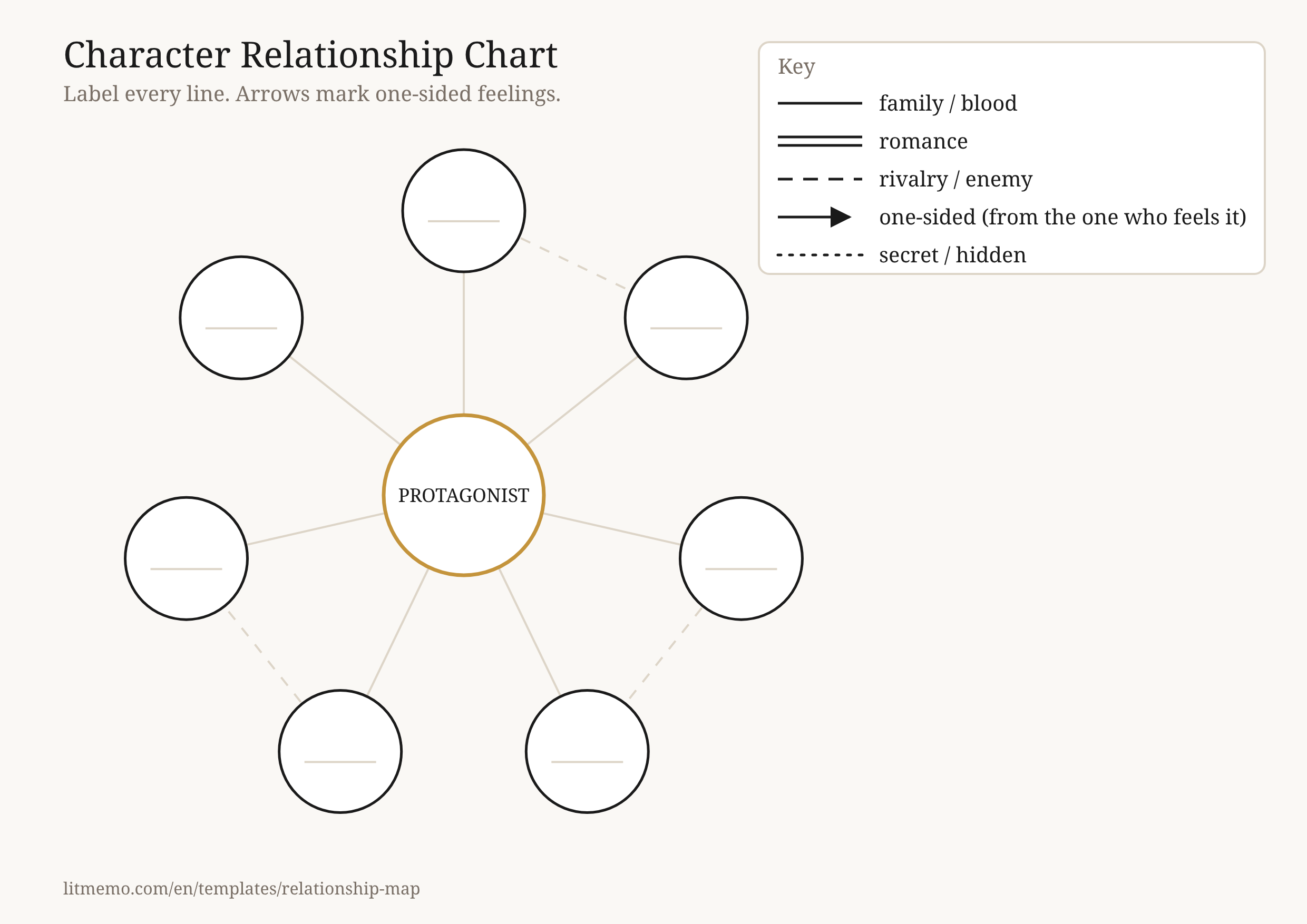
If you'd rather draw than type: a blank chart with eight character slots, a protagonist in the centre, and a key for line styles. Print it or open it in any image editor.
Field guide
A relationship chart falls apart when every line is the same line. Pick the type first; the line style follows. These twelve cover most casts.
Relationship types and how to draw them
| Field | What to write | Example |
|---|---|---|
| Family | Blood or adoptive kin — draw: Solid | Su Wan — Old Beggar (adoptive father) |
| Romance | Mutual romantic bond — draw: Double solid | Su Wan — Lu Chen (childhood friends → lovers) |
| One-sided | One feels it, the other doesn't know or doesn't return it — draw: Arrow, from the one who feels it | Lu Chen → Su Wan, first half of the book |
| Friendship | Chosen closeness without romance — draw: Solid, thinner | Lu Chen — Wei Lan |
| Rivalry | Competing for the same thing, not trying to destroy each other — draw: Dashed | Su Wan — Wei Lan (same bounty) |
| Enemy | One wants the other gone — draw: Dashed, heavier | Su Wan — Su Yuan (the uncle who sold the clan) |
| Mentor | One teaches, one learns — draw: Solid with a small circle at the mentor's end | Old Beggar — Su Wan |
| Debt | One owes the other, money or life — draw: Arrow, from the debtor | Wei Lan → Lu Chen |
| Alliance | Working together for now — draw: Solid, labelled with the goal | Su Wan — the Lighthouse Guild |
| Secret | A tie nobody else in the story knows about — draw: Dotted | Su Yuan — Guild Master |
| Former | Was one thing, is now another — draw: Solid crossed by a short bar; write both states | Su Wan — Lu Chen ("friends, ten years apart") |
| Subordinate | Reports to, serves, employed by — draw: Arrow from subordinate to superior | Guild members → Guild Master |
Two rules for a hand-drawn chart
Two rules that keep a hand-drawn chart readable: write the relationship type on the line, never just a line; and draw one-sided feelings as an arrow, so you can see at a glance who knows and who doesn't.
If a pair fits two types, draw both lines. A mentor who is also the enemy is exactly the kind of pair the chart exists to show.
Chart or table?
Use the table when you're still deciding — it's faster to add a row than to redraw a chart. Use the chart once the cast is set and you need to see the shape: who is isolated, which two characters have no line between them yet, where the plot has to go to connect them. Most writers keep both and update the table first.
The example cast, as a table
- Su Wan — Lu Chen: Childhood friends → lovers. Same alley, ten years apart; wary at the reunion, closer by ch. 12
- Su Wan — Old Beggar: Adoptive father. Raised her from seven; she pays for his medicine
- Su Wan — Su Yuan: Enemy (secret). Her uncle sold the clan; only she knows
- Su Wan — Wei Lan: Rivalry. Chasing the same bounty; respect, no trust
- Wei Lan — Lu Chen: Debt. Lu Chen covered his fine in ch. 3
- Su Yuan — Guild Master: Secret alliance. Their deal is the reveal in ch. 20
How to fill in this template
Once you have a big cast, relationships become a bottomless pit. Mentor-student, lovers, rivals, allies, blood ties… try to keep it all in your head and mistakes creep in as you write on: someone was clearly a friend earlier, then inexplicably turns into an enemy with no transition explained; or two characters' forms of address don't line up from one chapter to the next. A character relationship chart flattens this "web of characters" into a single list you can look things up in.
The simplest, most usable format is the one-row-at-a-time "Character A + relationship type + Character B," as if you were describing one connection after another. The "relationship type" can lock in the current state (mentor-student, lovers, rivals) or spell out how it evolves ("childhood friends → lovers," "comrades-in-arms → turned enemies") — the latter is especially good for relationships that shift with the plot.
The real value is in the "relationship notes" column. The relationship type only gives you a label, but "why they have this relationship" and "what happened between them" are the meat of the story. Write in the history of their bonds and grudges — when they met, what turned them against each other, whether there's an unresolved knot — and when you write conflict scenes you'll have ready-made emotional fuel instead of reinventing it every time.
We recommend starting from the protagonist: list every relationship directly tied to them first, then handle how the supporting characters relate to each other. A relationship usually runs both ways, and how A feels about B may differ from how B feels about A (one deeply in love, the other indifferent), so it's worth recording each direction separately. Once it's all laid out in the table, you may be surprised to find that some characters you assumed were close actually have no connection at all — and that's exactly the blank space the plot can work with.
Fill the template in four steps
Start with the protagonist
List every relationship directly tied to the protagonist first — their web of relationships is the heart of the whole story.
Label the relationship type
Give each pairing a type (mentor-student, lovers, rivals); for relationships that evolve, note where they're heading.
Fill in the relationship notes
Spell out the backstory of the relationship — when they met, what changed it, and any unresolved grudges.
Sort out the supporting cast's relationships
Then handle how the supporting characters relate to each other; when the feelings run different ways, it's worth recording each direction separately to complete the whole web.
Better together
Don't want to draw the table yourself? Do it with LitMemo
This template maps to these LitMemo features — fill it in online and everything auto-links:
Frequently asked questions
With a large cast the map explodes. How do I decide what to include?
Relationships change as the story moves. How do I maintain the map?
Does it have to be a diagram? Can I use a table?
How do I mark one-sided feelings?
Is there a relationship chart maker, or do I draw it by hand?
No download — use it online right away
Start filling without signing up, and auto-link characters, foreshadowing, and chapters