
Character Development Questionnaire: 100 Questions for Writers
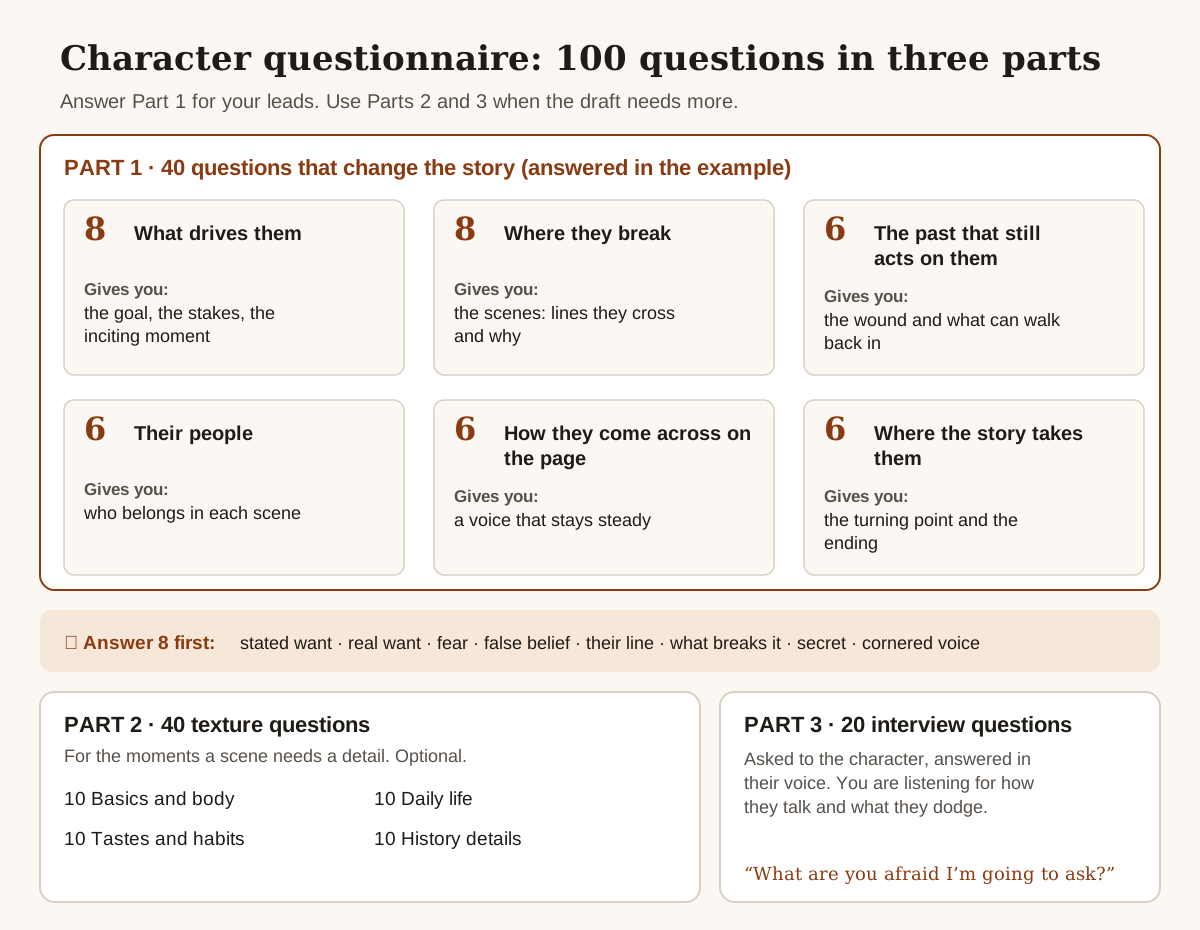
Forty questions that change what happens in your story, each one answered for a sample character so you can see what a useful answer looks like. Then forty texture questions for your leads and twenty character interview questions to ask in the character's own voice. Copy it, print it, or answer it straight onto a character card.
Create a character card — no sign-upA character questionnaire is a list of questions you answer about a character before or while you draft, so you know what they want, what they fear, and what they will do under pressure. This one is sorted by what each answer does to your story: what drives the character, where they break, the past that still acts on them, the people around them, how they sound on the page, and where the story takes them. Every one of those forty questions is answered for the same invented character, Ines Varga, a court interpreter whose brother is about to be named by a witness she is interpreting. The texture questions and the interview questions follow, and the whole questionnaire is below as plain text and as a Word file.
Or fill it in online, right in LitMemo.
Create a character card — no sign-upTemplate preview
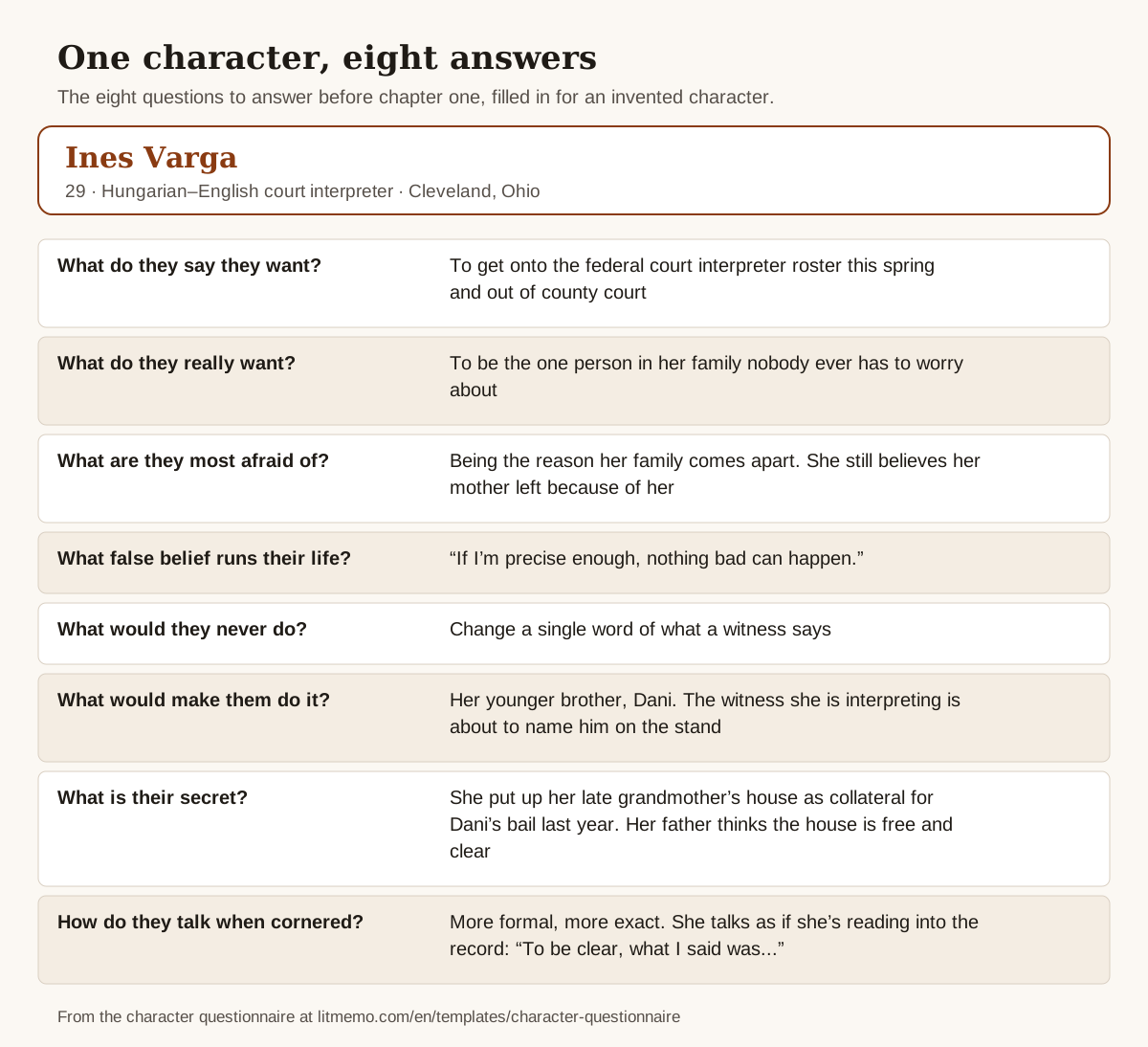
The eight questions to answer before chapter one, answered for Ines Varga
| Field | Example |
|---|---|
| Name | Ines Varga, 29. Court interpreter, Hungarian and English, Cuyahoga County, Ohio |
| What do they say they want? | To get onto the federal court interpreter roster this spring and out of county court |
| What do they really want? | To be the one person in her family nobody ever has to worry about |
| What are they most afraid of? | Being the reason her family comes apart. She still believes her mother left because of her |
| What false belief runs their life? | "If I'm precise enough, nothing bad can happen." |
| What would they never do? | Change a single word of what a witness says |
| What would make them do it? | Her younger brother, Dani. The witness she is interpreting is about to name him on the stand |
| What is their secret? | She put up her late grandmother's house as collateral for Dani's bail last year. Her father thinks the house is free and clear |
| How do they talk when cornered? | More formal, more exact. She talks as if she's reading into the record: "To be clear, what I said was..." |
Printable blank version
The Word file has all 100 questions with answer space under each, the eight starred questions on the first page, and Ines Varga's eight answers as a filled-in model. The image is the same eight answers on one page, for printing or pinning next to your desk.
Or fill it in online, right in LitMemo.
Create a character card — no sign-upField guide
The forty questions that change the story, in six groups by what the answer does: drives the plot, creates a scene, explains a choice, puts two people in a room, steadies the voice, or sets the ending. Each row says what the answer gives you and shows it answered for Ines Varga. She interprets Hungarian for the Cuyahoga County courts in Cleveland. Called in overnight to substitute in a murder trial, she recognizes the prosecution's key witness, an old neighbor of her late grandmother's, and he is about to say her brother's name on the stand.
What drives them
| Field | What to write | Example |
|---|---|---|
| What do they want, in words they'd say out loud? | The goal other characters can see. It gives your opening chapters a direction. | "Get on the federal roster by spring. Get out of county court." |
| What do they want that they would never admit? | The real goal. When the stated and real wants pull apart, you have a story. | To be the one Varga nobody has to rescue, and the one who does the rescuing. |
| Why now? What makes this the week it starts? | Your inciting moment. Without it, the want is just a wish. | The interpreter in a robbery-murder trial falls ill, and Ines is the only other Hungarian interpreter the court can get by morning. She recognizes the witness and says nothing. |
| What do they need that they don't know they need? | Where the story is taking them, whether they like it or not. | To let her brother answer for himself, and to stop treating love as a job she can do perfectly. |
| What are they most afraid of? | The thing your climax should force them to face. | Being the reason her family comes apart. |
| What do they believe about themselves that isn't true? | The false belief the plot will test. Every bad decision they make grows from it. | That her precision keeps her family safe. |
| What will they lose if they fail? | The stakes. Make them personal before you make them large. | Her certification, possibly a perjury charge, and either her brother or her own sense of who she is. |
| What are they best at, and how does it get them into trouble? | A strength that turns into a trap is more interesting than a flaw. | Precision. It makes her the best interpreter in the building, and it convinces her she could change one sentence and nobody would ever notice. |
Where they break
| Field | What to write | Example |
|---|---|---|
| What would they never do? | Their line. A story gets its strongest scene from pushing them to it. | Change a word of testimony. She has refused to soften a single curse in six years. |
| What would make them do it? | The exact pressure that breaks the line. It usually lands at the midpoint or the climax. | Mr. Fekete telling her, in Hungarian during a recess, that tomorrow on the stand he will say Dani's name. |
| What is their secret, and who would it hurt? | A reveal you can schedule. Decide who finds out, and when. | The house she put up for Dani's bail. It would hurt her father, who put the house in her name so it would stay in the family. |
| Who can hurt them most just by saying something? | Tells you who should be in the room for the worst scene. | Her father, Gabor, if he ever says "You sound like your mother." |
| What do they do first when things go wrong? | Their reflex under pressure. Readers learn the character from this faster than from any description. | Makes a list. Then calls Dani before she has decided what to say. |
| What is the worst decision they could make, and why are they tempted? | The wrong turn your second act can take. | Leave out one clause when she interprets Mr. Fekete. Nobody else in the room speaks Hungarian, and the court's audio recording only matters if someone thinks to check it. |
| What excuse will they give themselves when they cross the line? | Nobody thinks they are the villain. Write the rationalization in their own words. | An interpreter conveys meaning, not every syllable, and what Mr. Fekete meant was never really about Dani. |
| When did they try this before and fail? | A history of the same mistake makes the current one believable. | At nineteen she covered for Dani's first DUI by driving his car home herself. He got a second one a year later. |
The past that still acts on them
| Field | What to write | Example |
|---|---|---|
| What part of their past have they never told anyone in full? | The wound. Readers only need a piece of it, but you need all of it. | The night her mother left for Budapest, Ines, eleven, had told her she wished she would go. |
| Who raised them, and what rule did that person teach without saying it? | The unspoken rule they still obey. | Her grandmother Erzsebet, in the house on Buckeye Road, while her father worked nights. The rule: family business stays inside the house. |
| What did they want at twelve? | Shows how far they have drifted, or how little. | To be a translator for the United Nations, in a booth, where nobody could see her face. |
| What do they regret, and what did they do instead? | A regret gives them a reason to choose differently this time, or to repeat it. | Not visiting her mother when she had the money in 2021. She paid Dani's rent instead. |
| What from the past could walk back in? | A person, a document, or an object you can bring on stage when the plot needs it. | The lien the bail bond company recorded against the house. It is a county record anyone can look up. |
| What do they remember differently from everyone else? | A built-in argument with another character. | She remembers Dani as the kid who cried at every funeral. Her father remembers him as a liar since age six. |
Their people
| Field | What to write | Example |
|---|---|---|
| Who do they love, and how do they show it badly? | Love that comes out wrong is a scene engine. | Dani. She shows it by checking his bank balance and fixing his problems before he knows he has them. |
| Who do they owe? | Debt makes people do things they wouldn't otherwise do. | Marguerite Okafor, the senior interpreter who trained her and recommended her for the federal roster. |
| Who do they resent, and do they know it? | Hidden resentment surfaces at the worst moment, which is the right moment for you. | Her father, for leaving Dani to her after her grandmother got sick. She doesn't know it yet. |
| Who would they call at three in the morning? | The ally. Then decide whether that person will pick up. | Marguerite. Which is a problem, because Marguerite would report her. |
| Who in the story wants the opposite of what they want? | Your antagonist, or at least your opposing force, in one line. | Assistant prosecutor Ruth Kessler, who needs Mr. Fekete's testimony entered exactly as he gives it. |
| Who sees through them? | A character who can name the protagonist's lie lets you say it out loud. | Mr. Fekete. He knew her grandmother for forty years, and he knows exactly what Ines will do. |
How they come across on the page
| Field | What to write | Example |
|---|---|---|
| How do they talk when they're at ease? | Their baseline voice, so the reader notices when it changes. | Dry and fast. Switches to Hungarian for swearing and for food. |
| How do they talk when they're cornered? | The shift readers will learn to read as danger. | More formal, more exact, as if reading into the record: "To be clear, what I said was..." |
| What do they do with their hands when they're nervous? | One physical tell, used sparingly, does more than a paragraph of description. | Caps and uncaps her pen. In court the pen is for notes, so she presses her thumbnail into her index finger instead. |
| What do they notice first when they walk into a room? | Their point of view in a single detail. Use it for scene openings. | Who is speaking, and who is pretending not to listen. |
| What would they never say out loud? | The subtext under every conversation with the people closest to them. | "I'm tired of being the adult." |
| How do strangers misread them? | A first impression you can overturn. | Cold. Attorneys call her "the machine." |
Where the story takes them
| Field | What to write | Example |
|---|---|---|
| What do they get wrong in the opening chapters? | The mistake the reader can see before the character can. | She thinks it is a one-day substitution in a trial she knows nothing about. |
| What is the choice they can't take back? | The point of no return. Everything after it is consequence. | Whether to interpret the sentence that names Dani. |
| What must they give up to get what they need? | The real price of the ending. | The idea that she can protect everyone, and possibly her career. |
| Who are they at the end, in one line? | Gives the draft somewhere to go. You can change it later. | A woman who tells the truth in two languages and lets her brother carry his own. |
| What question will readers keep asking about them? | The suspense that belongs to this character alone. | Will she change the words? |
| What would make a reader stop rooting for them? | The line you must not let them cross, or must cross on purpose. | If she lets the man on trial go to prison for what Dani did. |
Plain-text version (copy & paste)
All 100 questions as plain text with space for answers, ready to paste into Google Docs, Word, Scrivener, Notion, or a notes app. The eight to answer first are marked with ★.
CHARACTER QUESTIONNAIRE (100 questions)
★ = the eight to answer before chapter one

PART 1: QUESTIONS THAT CHANGE THE STORY (40)

■ What drives them
1. What do they want, in words they'd say out loud? ★
2. What do they want that they would never admit? ★
3. Why now? What makes this the week it starts?
4. What do they need that they don't know they need?
5. What are they most afraid of? ★
6. What do they believe about themselves that isn't true? ★
7. What will they lose if they fail?
8. What are they best at, and how does it get them into trouble?

■ Where they break
9. What would they never do? ★
10. What would make them do it? ★
11. What is their secret, and who would it hurt? ★
12. Who can hurt them most just by saying something?
13. What do they do first when things go wrong?
14. What is the worst decision they could make, and why are they tempted?
15. What excuse will they give themselves when they cross the line?
16. When did they try this before and fail?

■ The past that still acts on them
17. What part of their past have they never told anyone in full?
18. Who raised them, and what rule did that person teach without saying it?
19. What did they want at twelve?
20. What do they regret, and what did they do instead?
21. What from the past could walk back in?
22. What do they remember differently from everyone else?

■ Their people
23. Who do they love, and how do they show it badly?
24. Who do they owe?
25. Who do they resent, and do they know it?
26. Who would they call at three in the morning?
27. Who in the story wants the opposite of what they want?
28. Who sees through them?

■ How they come across on the page
29. How do they talk when they're at ease?
30. How do they talk when they're cornered? ★
31. What do they do with their hands when they're nervous?
32. What do they notice first when they walk into a room?
33. What would they never say out loud?
34. How do strangers misread them?

■ Where the story takes them
35. What do they get wrong in the opening chapters?
36. What is the choice they can't take back?
37. What must they give up to get what they need?
38. Who are they at the end, in one line?
39. What question will readers keep asking about them?
40. What would make a reader stop rooting for them?

PART 2: TEXTURE (40)

■ Basics and body
41. Full name, and every name other people call them
42. Age at the start of the story, and how they feel about that age
43. Where were they born, and where do they live now?
44. What do they look like in three details a reader would notice if they changed?
45. How do they move: walk, sit, stand in a line?
46. What do they wear on an ordinary day, and on the day that matters?
47. Any scars, injuries, or health conditions, and how they affect daily life
48. How do they sound: pitch, accent, speed?
49. Do they think of themselves as attractive?
50. What class did they grow up in, and where do they feel out of place now?

■ Daily life
51. What do they do for a living, and how do they feel about it?
52. What does a normal Tuesday look like, hour by hour?
53. Where do they go when they need to be alone?
54. What is in their pockets or bag right now?
55. How much money do they have, and how much do they think about it?
56. What is their home like, and who else lives there?
57. How do they get around?
58. What do they eat when nobody is watching?
59. How do they sleep?
60. What is the last thing they bought for themselves?

■ Tastes and habits
61. What do they do to relax?
62. What music, books, shows, or games do they love, and which do they pretend to love?
63. Any hobbies or skills nobody would guess?
64. What habit annoys the people who live with them?
65. What are they good at that they don't value?
66. Do they prefer routine or surprise?
67. Introvert or extrovert, and where do they recharge?
68. Any superstitions or private rituals?
69. Who do they want now, and how do they handle getting close?
70. What do they always forget?

■ History details
71. What were they like at school?
72. Who was their first friend, and what happened to that friendship?
73. Their first love, and how it ended
74. The happiest day of their life
75. The day they were most ashamed
76. A time they were brave
77. The worst job they ever had
78. Their religion or beliefs, then and now
79. Their politics, and how loudly they hold them
80. A place they have always wanted to go, and why they haven't

PART 3: CHARACTER INTERVIEW, ASKED IN THEIR VOICE (20)

81. What should I call you?
82. What did you do this morning?
83. What is the thing you are proudest of that nobody knows about?
84. Who do you think about when you can't sleep?
85. What do people get wrong about you?
86. What is the worst thing you have ever done?
87. What would you do with a free year?
88. What do you want to happen next in your life?
89. What are you afraid I'm going to ask you?
90. Who in your family are you most like?
91. Tell me about a fight you lost.
92. What makes you laugh when you shouldn't?
93. What would you never forgive?
94. Who would you take a bullet for, and who do you only say you would?
95. What is the last lie you told?
96. What do you want written on your headstone?
97. If you could change one decision, which one?
98. What are you hiding in this conversation?
99. What would make you walk out of this room right now?
100. Is there anything you'd like to ask me?
Questions that change the plot, and questions that add texture
The long questionnaires in circulation mix two kinds of questions. Some decide what happens: what the character wants, what they would never do, what would make them do it. Others add detail: a favorite meal, a star sign. Both are useful, but only the first kind can save a stalled draft.
This questionnaire keeps them apart. Part 1 has the forty that change the story, each answered in the example. Part 2 has forty texture questions for the leads. Part 3 is the character interview. A quick test for any question you add: if the answer changed, would a scene change? If yes, it goes in Part 1.
How to turn the answers into scenes
- What they want → the goal of your first act. Show them going after it on page one.
- What would make them cross their line → your midpoint. Build the situation that applies exactly that pressure.
- Their secret → a reveal with a date on it. Decide which chapter it comes out in, and who learns it first.
- Who can hurt them by saying something → the two people in your worst scene. Write the line before you write the scene.
- What they do first when things go wrong → their reaction in every crisis scene, until the moment they do something different.
- The choice they can't take back → your point of no return. Everything after it is consequence.
For Ines, that is six scenes before a word of the outline: the exam application, the recess when Mr. Fekete tells her what he will say tomorrow, the lien on the house surfacing, her father's line about her mother, the list she writes in the courthouse restroom, and the sentence she decides whether to interpret.
How to run a character interview
The character interview questions in Part 3 are written to the character, not about them. Set a timer for twenty minutes, imagine them across a table, and answer as them, in first person, in their own words. Don't edit while you write.
Pay attention to what they refuse to answer, change the subject on, or answer too quickly. Ines, asked "What are you afraid I'm going to ask you?", answers by asking what exactly is meant by "afraid." That deflection is her voice, and it goes straight into the sheet under how she talks when cornered.
How many questions each character needs
- Protagonist, and an antagonist with real page time: all forty in Part 1, and the interview.
- Point-of-view characters and love interests: the eight starred questions, plus the Their people group.
- Supporting characters who return: the eight starred questions, a line each.
- Walk-on parts: what they want from the lead, one physical detail, one way of talking.
How to fill in this template
Start with the eight questions in the table. They take about twenty minutes for one character, and they are enough to write the first scene. Answer the rest of the forty questions that change the story before your first big turning point, or whenever you get stuck.
Answer in sentences, and be specific. "She's afraid of failure" gives you nothing to write. "She's afraid of being the reason her family comes apart" gives you a scene: someone accuses her of exactly that. If an answer doesn't suggest a scene, a choice, or a line of dialogue, ask the question again and push further.
Skip freely. The texture questions are there for the moments a draft needs a detail: what is in her bag, where she goes to be alone. Nobody needs a favorite color for a character who appears twice.
Expect the answers to change. A character usually becomes clearer after a few chapters than they were in your planning notes. When that happens, update the answers to match the draft, then reread the earlier chapters for anything the change breaks.
Fill the template in four steps
Answer the eight starred questions
Want, real want, fear, false belief, the line they won't cross, what would make them cross it, their secret, and how they talk when cornered. This is the minimum for any character with a point of view.
Work through the forty that change the story
Go group by group. For each answer, note the scene it suggests. Those notes become the first draft of your outline.
Run a character interview
Ask the twenty interview questions and answer in the character's voice, first person, without stopping to edit. You are listening for how they talk and what they avoid saying.
Keep the answers where you write
Move the answers onto the character's card or sheet, next to the manuscript, and check them before every scene with that character.
Better together
Work it straight into your story
This template maps to these LitMemo features — fill it in online and everything auto-links:
Want to write it better? Start with these
Frequently asked questions
What is a character questionnaire?
What are the most important character development questions?
How many questions should I answer for each character?
What is the difference between a character questionnaire and a character interview?
Should I fill out the questionnaire before I start writing?
Can I download the character questionnaire?
Is this the same as a character sheet?
Or fill it in online — make the character card right here
Start without signing up, then link the character to foreshadowing and chapters