
Character Arc Template
The Lie, the Want, and the Need, then nine stages mapped to chapters, with a filled-in example of a positive, a negative, and a flat arc. Plus a copy-paste version you can fill in for your own character.
Create a character card — no sign-upA character arc template is a worksheet for planning how a character changes over a story: the false belief they start with (the Lie), what they chase (the Want), what they actually need, and the stages where that belief gets tested, each placed in a chapter. This one has nine stages on the same turning points as three-act structure, a fully filled-in positive arc for a diner owner in small-town Ohio, filled-in negative and flat arc examples, and a plain-text version to paste into Google Docs, Word, or Scrivener.
Or fill it in online, right in LitMemo.
Create a character card — no sign-upTemplate preview
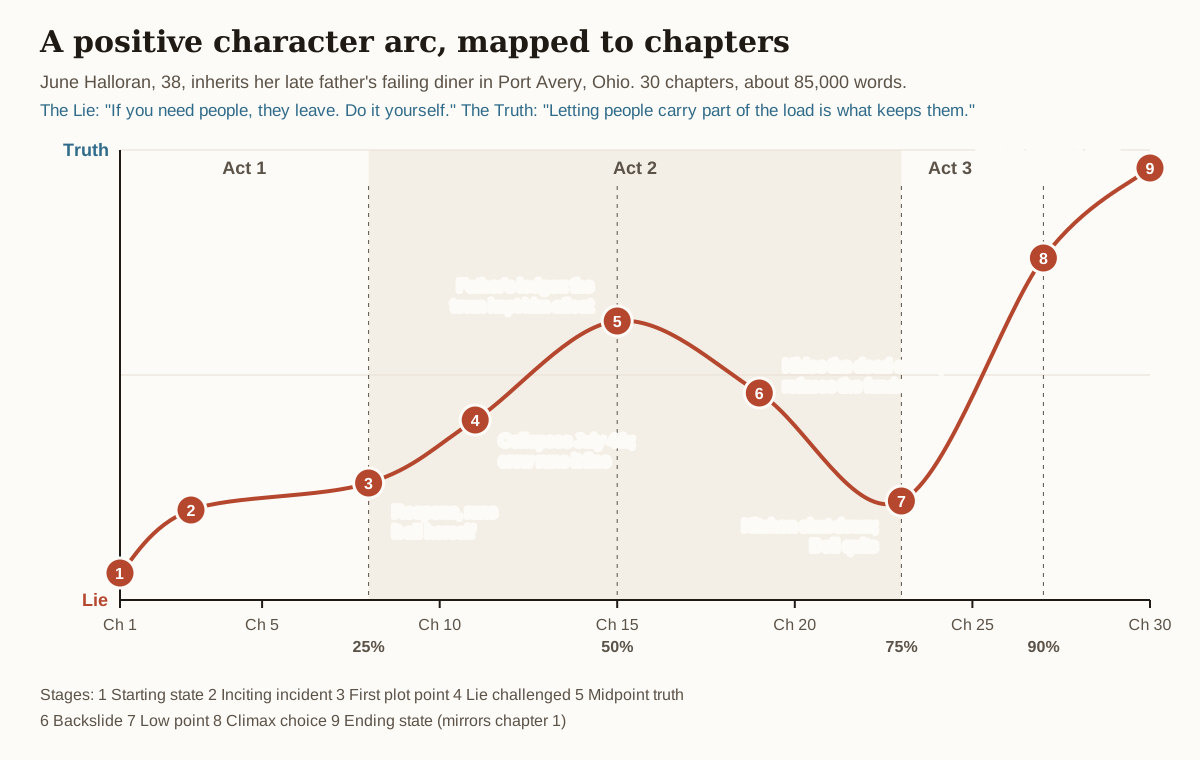
The arc at a glance, filled in for June Halloran
| Field | Example |
|---|---|
| Character | June Halloran, 38, sous-chef who inherits her late father's failing diner in Port Avery, Ohio |
| Arc type | Positive: she gives up a Lie and ends the book living by the Truth |
| The Lie she believes | "If you need people, they leave. Do it yourself." |
| The Truth | Letting people carry part of the load is what keeps them |
| What she wants | Sell the diner and be back at her Chicago job by Labor Day |
| What she needs | To let the town, and her father's old crew, help her |
| Starting state (ch. 1) | Works a double alone and waves off a coworker who offers to cover her shift |
| Midpoint shift (ch. 15) | Finds her father's ledger: for years the town quietly kept the diner afloat, and he let them |
| Low point (ch. 23) | The county shuts the kitchen over a cooler failure she hid, the buyer walks, and her cook quits |
| Climax choice (ch. 27) | Instead of signing the sale, she stands up at the town meeting and asks for help |
| Ending state (ch. 30) | Hands her cook the keys and the Sunday dinner service, and takes the night off |
Printable blank version
The blank arc template with a line for every field and all nine stages. Print it, or fill it in on screen.
Or fill it in online, right in LitMemo.
Create a character card — no sign-upField guide
The preview above is the whole arc on one card. Below, every field is broken out: what goes in it, and how it reads filled in for June Halloran, a 38-year-old sous-chef who inherits her father's diner in a 30-chapter, 85,000-word novel. Fill in the engine first; the nine stages build on it. The Lie and Truth vocabulary comes from K.M. Weiland's Creating Character Arcs.
The engine: fill these first
| Field | What to write | Example |
|---|---|---|
| The Lie | The false belief your character runs on at the start. Write it as a sentence they would say out loud, in their voice. Every bad choice in Act 1 should make sense if you believe this sentence. | "If you need people, they leave. Do it yourself." |
| The Truth | The belief that replaces the Lie by the end (positive arc), the one they reject (negative arc), or the one they already hold (flat arc). One sentence, the mirror of the Lie. | Letting people carry part of the load is what keeps them. |
| The ghost (wound) | The event in the past that taught them the Lie. Readers rarely need the full story; you need it so the Lie has a reason. | Her mother walked out when June was nine. Her father worked eighteen-hour days and told her never to owe anybody. She grew up believing he did it all alone. |
| Want | The outside goal they chase on the page. Concrete, with a deadline if you can manage one. It usually serves the Lie. | Sell the diner and be back at her sous-chef job in Chicago when her leave ends on Labor Day. |
| Need | What would actually fix their life. They can't see it at the start, and getting it usually costs them the Want. | To let the town, and her father's old crew, help her. |
| Protective habit | How the Lie shows up as behavior before page one: the habit that keeps them safe and keeps them stuck. This is what you put on the page, so the Lie never has to be said out loud. | Does every prep list herself, refuses favors, pays for her own coffee at the counter, and leaves a room before anyone can leave her. |
| Foil | The character who embodies the Lie, or the Truth, so the protagonist can see it from outside. Often the antagonist, the love interest, or a mentor. | Dell, her father's cook for thirty years, who takes help and gives it without keeping score. |
The nine stages, mapped to chapters
| Field | What to write | Example |
|---|---|---|
| 1. Starting state (0–10% · ch. 1–3) | Show the Lie in action before anything happens to them. One scene where the Lie costs them something small. | Works a double alone at her Chicago restaurant and turns down a coworker's offer to cover her shift. Gets the call about her father, takes two weeks' leave, and in Port Avery turns the neighbors away at the door. |
| 2. Inciting incident (~10% · ch. 3) | The event that pushes them out of their normal life. It should hit the Want directly. | The buyer lined up for the building pulls out over a county tax lien. The only way to clear the debt before the bank's Labor Day deadline is to reopen for the summer tourist season. She extends her leave. |
| 3. First plot point (~25% · ch. 7–8) | They commit to the new situation, still holding the Lie. The decision should be one they can't easily undo. | She reopens, rehires only Dell, her father's cook, and insists on doing the books, the prep, and the register herself. |
| 4. Lie challenged (~37% · ch. 11) | The story pushes on the Lie for the first time. They get a glimpse of the Truth and explain it away. | She collapses from exhaustion during the Fourth of July rush. Dell and the regulars run the floor without her and it goes fine, which scares her more than the collapse. |
| 5. Midpoint truth (~50% · ch. 15) | They see the Truth clearly for the first time. They don't act on it fully yet, but they can't unsee it. | In the back office she finds her father's ledger: for years the town paid tabs forward, the crew worked winters for half pay, and he let them. He did none of it alone. |
| 6. Backslide (~62% · ch. 19) | Under new pressure they grab the Lie again, harder than before. This is what makes the climax feel earned. | A new buyer offers just enough to clear the debt, if the diner stays profitable through August. When the walk-in cooler dies, she hides it from the crew, works triple shifts to cover the loss, and turns down the regulars' fundraiser. |
| 7. Low point (~75% · ch. 22–23) | The third plot point: the Lie fails them completely and they lose what it was supposed to protect. The chapters right after are where they sit with the wreckage. | The county inspector shuts the kitchen for a week over the cooler. The buyer walks, the crew learns what she hid, and Dell quits. She is alone, which is what the Lie promised, and she did it to herself. |
| 8. Climax choice (~90% · ch. 27) | They choose between the Lie and the Truth, and the choice costs them something real. | She stands up at the town meeting and asks for help: the fundraiser, and a co-op of regulars to own the diner with her. It means giving up the Chicago job for good. |
| 9. Ending state (95–100% · ch. 29–30) | Show who they are now, ideally in a scene that mirrors the starting state. | Labor Day weekend. The diner stays open as a co-op, Dell is back, and June hands him the keys and the Sunday dinner service and takes the night off. |
Proof on the page
| Field | What to write | Example |
|---|---|---|
| Opening mirror scene | The chapter 1 scene that shows the Lie. Write it down here so you can echo it at the end. | A coworker offers to cover her shift; June says no and works till 2 a.m. |
| Closing mirror scene | The same situation near the end, answered the other way. Readers feel the arc here without being told. | Dell offers to run Sunday dinner; June says yes, hands him the keys, and goes down to the lake. |
| Who notices the change | One other character who sees the change and reacts. Their reaction confirms it for the reader. | Dell, weighing the keys in his hand: "Took your dad thirty years to give anybody these." |
Plain-text version (copy & paste)
Every field as plain text, ready to paste into Google Docs, Word, Scrivener, or Notion. Fill in the chapter numbers for your own book. The last two blocks are the fields to swap in for a negative or a flat arc.
■ The engine
Character:
Arc type (positive / negative / flat):
The Lie they believe (one sentence, in their voice):
The Truth (one sentence):
The ghost / wound behind the Lie:
Protective habit (how the Lie looks in action):
Foil (who embodies the Lie or the Truth):
Want (outside goal + deadline):
Need (what would actually fix their life):

■ The nine stages (% of the book · chapter)
1. Starting state, Lie in action (0–10% · ch. __):
2. Inciting incident (~10% · ch. __):
3. First plot point, commits with the Lie intact (~25% · ch. __):
4. Lie challenged (~37% · ch. __):
5. Midpoint truth (~50% · ch. __):
6. Backslide (~62% · ch. __):
7. Low point / third plot point (~75% · ch. __):
8. Climax choice (~90% · ch. __):
9. Ending state (95–100% · ch. __):

■ Proof on the page
Opening mirror scene:
Closing mirror scene:
Who notices the change:

■ Negative arc: swap these in
Type (disillusionment / fall / corruption):
Truth they start with or are offered:
Lie they end up living by:
The choice that seals it (~90%):
What it costs them and others:

■ Flat arc: swap these in
The Truth they already hold:
The Lie the world around them believes:
Who changes because of them:
The moment the Truth is tested hardest (~75%):
How the world looks different at the end:
The three types of character arcs, each filled in
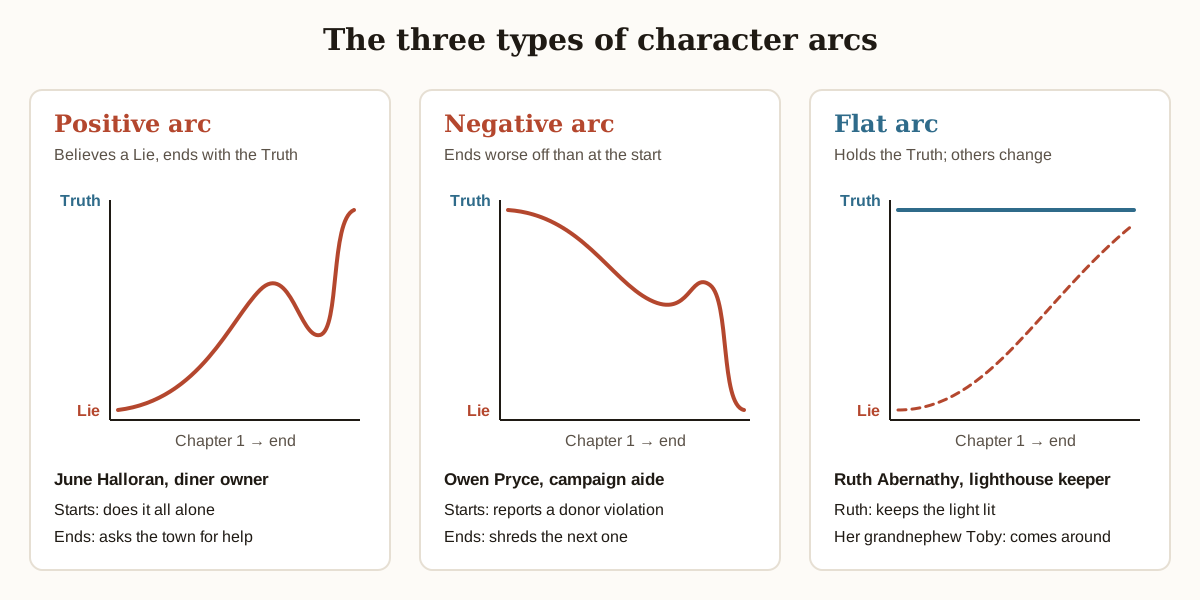
Every character arc tests what a character believes. In a positive arc the belief changes from the Lie to the Truth. A negative arc ends worse: the character rejects the Truth, or learns it too late. A flat arc keeps the character steady on the Truth while the people around them change. June above is a positive arc. Here are the other two, built on the same engine.
Negative arc, corruption type: Owen Pryce, 29, deputy campaign manager in a state senate race (political thriller, 28 chapters).
- Truth he starts with: the rules are what protect people who can't protect themselves.
- Lie he adopts: win first; you can fix things once you're in charge.
- Want: get his candidate elected. Need: hold the line when it costs him.
- Starting state: reports a donor's illegal contribution even though it costs the campaign a week of bad headlines.
- Midpoint: buries a story about the candidate's brother to protect the polling lead, and tells himself it's the last time.
- Low point: a staffer finds the file he buried and threatens to take it to the press.
- Climax choice: Owen helps plant a false story that ends her career.
- Ending state: chief of staff. When an intern brings him the next violation, he tells her to shred it.
Flat arc: Ruth Abernathy, 71, keeper of the Gannet Point light on the Maine coast, 1931 (historical, 24 chapters).
- The Truth she holds: a light you only keep when it's convenient isn't a light.
- The Lie the town believes: look away on the right nights and nobody gets hurt. Rum-runners pay well to have the light go dark.
- Who changes: Toby, her 17-year-old grandnephew, who runs boats for the smugglers.
- Hardest test: a storm night with a smuggling run due, a payment left on her doorstep, and Toby asking her to let the light go out.
- Ending state: the light never goes dark. Toby testifies against the ring, and the town's harbor goes back to fishing boats.
Negative arcs come in three shapes, following K.M. Weiland's breakdown: disillusionment (they learn the Truth, and it leaves them in a darker place), fall (they never escape the Lie and end worse off), and corruption (they start with the Truth and trade it for a Lie, as Owen does).
How the nine stages change for negative and flat arcs
The stages sit on the same chapters for all three types. What happens at each one changes:
- Starting state: positive and fall arcs open in the Lie; corruption and flat arcs open with the character holding the Truth.
- Lie challenged (~37%): positive, they glimpse the Truth and explain it away; negative, they glimpse it and push it off; flat, the world pushes back on their Truth for the first time.
- Midpoint (~50%): positive, they see the Truth clearly; negative, they see it and turn away (in a corruption arc, they make their first real compromise); flat, someone close to them starts to doubt the Lie.
- Low point (~75%): positive, the Lie costs them everything; negative, the Truth asks a price they refuse to pay; flat, holding the Truth costs them the most it ever will.
- Climax choice (~90%): positive, they choose the Truth; negative, they choose the Lie for good; flat, they hold, and the people around them choose.
- Ending state: show the new normal, the ruin, or the changed world, in a scene that mirrors chapter 1.
Mapping the arc to your chapters and word count
The nine stages sit on the same percentage marks as three-act structure, so your arc and your plot turn at the same moments. Multiply the percentage by your target length to find where each stage lands.
- 60,000 words: first plot point ~15,000 · midpoint ~30,000 · low point ~45,000 · climax choice ~54,000
- 85,000 words: first plot point ~21,000 · midpoint ~42,500 · low point ~64,000 · climax choice ~76,500
- 100,000 words: first plot point ~25,000 · midpoint ~50,000 · low point ~75,000 · climax choice ~90,000
- 30 chapters: first plot point ch. 7–8 · midpoint ch. 15 · low point ch. 22–23 · climax choice ch. 27
Treat these as targets to aim near. If your midpoint truth lands at 40% or 60%, the arc still works. Trouble starts when a stage is missing: no backslide, and the climax feels too easy; no midpoint truth, and the change at the end comes out of nowhere.
Which characters need an arc
- Protagonist: a full nine-stage arc.
- Antagonist, love interest, or second lead: a shorter arc of four stages works (starting state, Lie challenged, climax choice, ending state).
- Mentor or steady supporting character: often a flat arc. Fill in the Truth they hold and who changes because of them.
- Walk-on characters: no arc. A line on a character sheet is enough.
How to fill in this template
A character arc template is a plan for how a character changes between page one and the last page, broken into stages you can place in specific chapters. The plot is what happens to them. The arc is what it does to them.
Fill the engine first, in this order: the Lie, the Truth, the Want, the Need. If you can't write the Lie as one sentence the character would say out loud, the stages will come out vague. Once the Lie is clear, most stages write themselves: each one is the story pushing on that sentence a little harder.
Then set each stage against a chapter. Pair every stage with a scene you can point to. "She learns to trust people" is a summary. "Dell runs the Fourth of July rush without her and it goes fine" is a scene, and it tells you what to write on the day you reach chapter 11.
In LitMemo, the arc sits next to your outline and timeline. Each outline beat can link to the characters in it and to a timeline event, and turns into a chapter when you're ready to write it. On the timeline, an event can record how it changed a character: pick the character and the field, and write the new value. The change carries forward from that event, so you can check who June is at chapter 11 and at chapter 27 while her character sheet stays as she was on page one.
Fill the template in four steps
Write the Lie and the Truth
One sentence each, in the character's voice. The Lie is what they believe at the start; the Truth is its mirror.
Name the Want and the Need
The Want is the outside goal they chase. The Need is what would actually fix their life, and it usually costs them the Want.
Pick the arc type
Positive (Lie to Truth), negative (ends worse off), or flat (holds the Truth while others change). Swap in the matching fields from the copy-paste version.
Place the nine stages in chapters
Use the percentages to find the chapter for each stage, then write one concrete scene per stage.
Write the two mirror scenes
Plan an opening scene that shows the Lie and a closing scene that answers the same situation the other way.
Better together
Work it straight into your story
This template maps to these LitMemo features — fill it in online and everything auto-links:
Want to write it better? Start with these
Frequently asked questions
What are the types of character arcs?
What's the difference between a character's want and need?
Can a main character have a flat arc?
Does every character need an arc?
How do character arcs work across a series?
Does this work with Save the Cat or the Hero's Journey?
Is there a printable or Word version?
Or fill it in online — make the character card right here
Start without signing up, then link the character to foreshadowing and chapters